
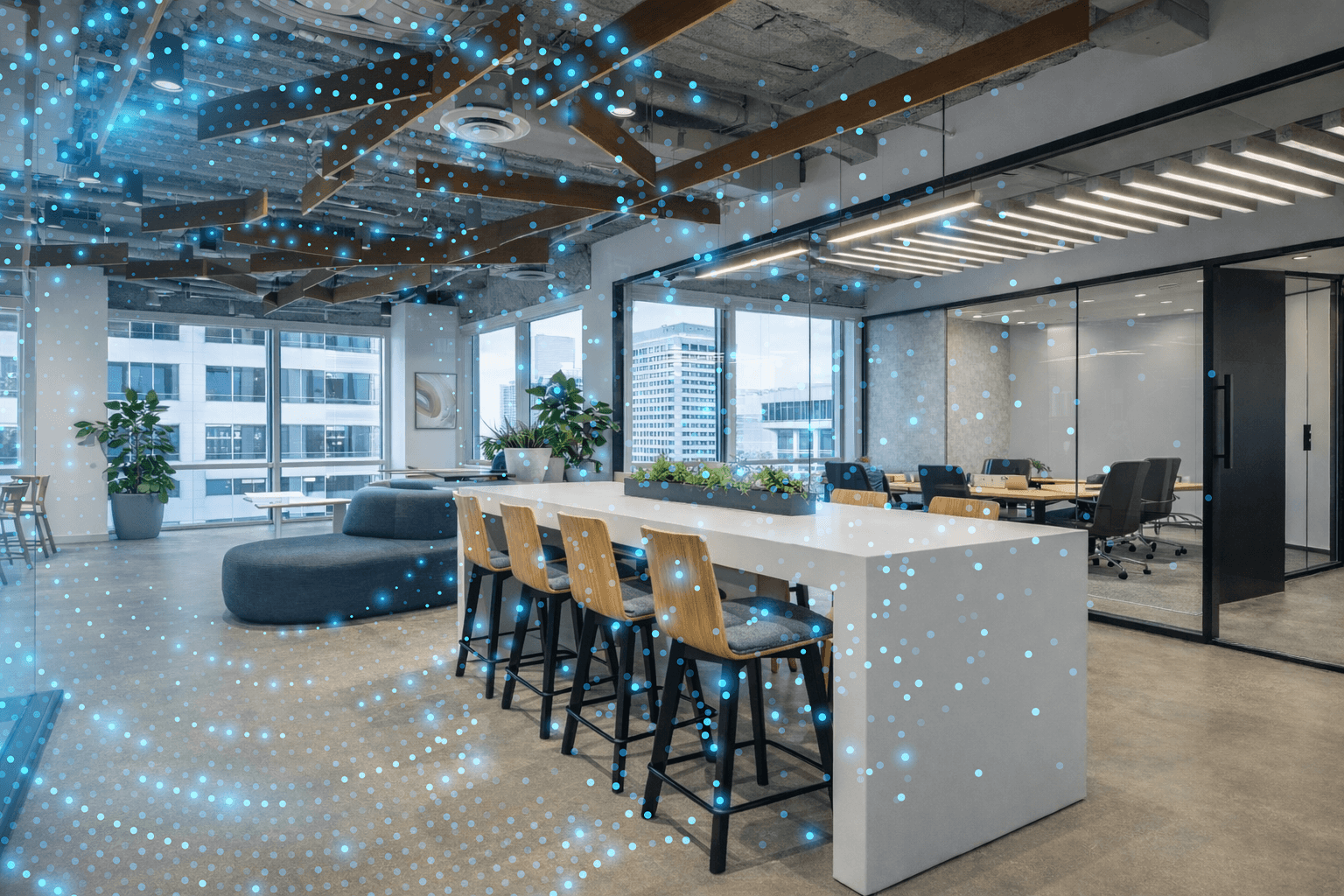
Smart workspace technology.
Building automated, integrated and intuitive workspaces
Smart workspace technology.
Building automated, integrated and intuitive workspaces
February 2026
February 2026
Over the past few years, the workplace has been reimagined again and again. Hybrid working, shifting employee expectations, rising operational costs and rapid technology innovation have all forced organisations to rethink what the office is for – and how it should perform.
But while much of the conversation has focused on where people work, a more fundamental question often goes unchallenged: does the workspace actually work as a joined-up system?
For many organisations, the honest answer is no.
The real challenge isn’t technology, it’s integration
Most modern offices are already rich in technology. Access control, connectivity, collaboration tools, workspace booking platforms, print and document workflows, digital signage and refreshment solutions are all commonplace.
Individually, these systems often perform well. Collectively, they frequently fall short.
That’s because ownership of the workspace is typically fragmented. IT optimises for resilience and security. Facilities focuses on space, services and cost control. HR priorities employee experience and wellbeing. Finance, quite rightly, scrutinises investment, cost models and return. Each function makes sensible decisions in isolation, but the result is rarely a coherent experience for the people using the workspace.
The consequences are familiar: employees navigating multiple systems just to get through the day, meeting spaces that look well-specified on paper but fail at the point of use, productivity lost to avoidable outages and day-to-day friction, and technology investment that never quite translates into measurable outcomes.
This isn’t a failure of ambition. It’s a failure of smart workspace integration.
Why smart workspace integration matters now
After nearly a year, I’m convinced this sector is at an inflection point. Businesses that treat refreshments as a strategic part of workplace design – rather than a box-ticking exercise – will attract, retain and energise the best people. Those who don’t will miss an opportunity hiding in plain sight.
It’s been a joy to rediscover the thrill of change in a completely new context, and to see first-hand how the smallest details, such as a well-placed water tap or a perfectly brewed coffee, can shape culture just as powerfully as any technology platform ever could.
If this perspective on workplace refreshment strategy resonates with you, I’d welcome a conversation – after all, sharing experiences and best practice is often where the next great idea begins.
Moving beyond silos to a whole-workspace view
One of the biggest barriers to effective smart workspace integration is organisational structure. Workspace decisions are still too often made within functional silos, each optimising locally but sub-optimising globally.
A joined-up approach requires stepping back and asking broader, business-level questions:
Where are integration gaps undermining productivity, employee experience or financial performance?
Which issues are being treated as ‘IT problems’ or ‘FM problems’ when they are actually organisational ones?
How do workspace decisions support resilience, wellbeing, performance and measurable return, not just procurement or compliance?
Without this perspective, even well-intentioned investments struggle to deliver lasting value.
Supporting smart workspace integration end to end
Focusing on outcomes rather than individual systems, we support our clients to achieve the best real-terms return on their investment.
Once defined, the next step is consistency. Establishing a Global Workspace Operating Model (GWOM) enables organisations to codify what ‘good’ looks like – creating a definitive workspace model that can be deployed consistently across regions, markets and sites. This ensures alignment between IT, FM, HR and Finance, while maintaining local flexibility within a clearly defined global framework.
This can mean helping employees gain clearer visibility and control over how the workspace works day to day; improving connectivity and resilience across devices and locations; reducing disruption caused by IT outages and operational failures; simplifying document workflows & printing while maintaining security and compliance; making collaboration in meeting and shared spaces genuinely frictionless; improving how organisations communicate digitally with employees and visitors; and enhancing the everyday workplace experience, including refreshment and amenities.
Where organisations operate internationally, we also support the structured rollout of this model globally – ensuring that smart workspace integration is delivered consistently across multiple territories without losing sight of local operational realities.
The focus isn’t on adding more technology for its own sake, but on spotting where fragmented ownership and disconnected decisions are quietly eroding value, and fixing those gaps through smart workspace integration.
Creating workplaces people want to be in – and perform in
The most effective workplaces today are not defined by the number of systems they deploy, but by how seamlessly those systems work together. When automation reduces disruption, integration removes friction, and intuitive design puts people first, the workspace becomes a genuine business asset – supporting productivity, wellbeing and organisational performance.
For organisations navigating this shift, smart workspace integration is no longer optional. It is the foundation for building automated, integrated and intuitive workplaces that deliver real results – and, when formalised through a clear Global Workspace Operating Model, those results can be replicated and scaled worldwide.
If you’re starting to question whether your workspace is truly joined up – or suspect that well-intentioned investments aren’t quite delivering what they should – a short discovery conversation can help clarify where the gaps really are. Get in touch to book your call today.
Over the past few years, the workplace has been reimagined again and again. Hybrid working, shifting employee expectations, rising operational costs and rapid technology innovation have all forced organisations to rethink what the office is for – and how it should perform.
But while much of the conversation has focused on where people work, a more fundamental question often goes unchallenged: does the workspace actually work as a joined-up system?
For many organisations, the honest answer is no.
The real challenge isn’t technology, it’s integration
Most modern offices are already rich in technology. Access control, connectivity, collaboration tools, workspace booking platforms, print and document workflows, digital signage and refreshment solutions are all commonplace.
Individually, these systems often perform well. Collectively, they frequently fall short.
That’s because ownership of the workspace is typically fragmented. IT optimises for resilience and security. Facilities focuses on space, services and cost control. HR priorities employee experience and wellbeing. Finance, quite rightly, scrutinises investment, cost models and return. Each function makes sensible decisions in isolation, but the result is rarely a coherent experience for the people using the workspace.
The consequences are familiar: employees navigating multiple systems just to get through the day, meeting spaces that look well-specified on paper but fail at the point of use, productivity lost to avoidable outages and day-to-day friction, and technology investment that never quite translates into measurable outcomes.
This isn’t a failure of ambition. It’s a failure of smart workspace integration.
Why smart workspace integration matters now
After nearly a year, I’m convinced this sector is at an inflection point. Businesses that treat refreshments as a strategic part of workplace design – rather than a box-ticking exercise – will attract, retain and energise the best people. Those who don’t will miss an opportunity hiding in plain sight.
It’s been a joy to rediscover the thrill of change in a completely new context, and to see first-hand how the smallest details, such as a well-placed water tap or a perfectly brewed coffee, can shape culture just as powerfully as any technology platform ever could.
If this perspective on workplace refreshment strategy resonates with you, I’d welcome a conversation – after all, sharing experiences and best practice is often where the next great idea begins.
Moving beyond silos to a whole-workspace view
One of the biggest barriers to effective smart workspace integration is organisational structure. Workspace decisions are still too often made within functional silos, each optimising locally but sub-optimising globally.
A joined-up approach requires stepping back and asking broader, business-level questions:
Where are integration gaps undermining productivity, employee experience or financial performance?
Which issues are being treated as ‘IT problems’ or ‘FM problems’ when they are actually organisational ones?
How do workspace decisions support resilience, wellbeing, performance and measurable return, not just procurement or compliance?
Without this perspective, even well-intentioned investments struggle to deliver lasting value.
Supporting smart workspace integration end to end
Focusing on outcomes rather than individual systems, we support our clients to achieve the best real-terms return on their investment.
Once defined, the next step is consistency. Establishing a Global Workspace Operating Model (GWOM) enables organisations to codify what ‘good’ looks like – creating a definitive workspace model that can be deployed consistently across regions, markets and sites. This ensures alignment between IT, FM, HR and Finance, while maintaining local flexibility within a clearly defined global framework.
This can mean helping employees gain clearer visibility and control over how the workspace works day to day; improving connectivity and resilience across devices and locations; reducing disruption caused by IT outages and operational failures; simplifying document workflows & printing while maintaining security and compliance; making collaboration in meeting and shared spaces genuinely frictionless; improving how organisations communicate digitally with employees and visitors; and enhancing the everyday workplace experience, including refreshment and amenities.
Where organisations operate internationally, we also support the structured rollout of this model globally – ensuring that smart workspace integration is delivered consistently across multiple territories without losing sight of local operational realities.
The focus isn’t on adding more technology for its own sake, but on spotting where fragmented ownership and disconnected decisions are quietly eroding value, and fixing those gaps through smart workspace integration.
Creating workplaces people want to be in – and perform in
The most effective workplaces today are not defined by the number of systems they deploy, but by how seamlessly those systems work together. When automation reduces disruption, integration removes friction, and intuitive design puts people first, the workspace becomes a genuine business asset – supporting productivity, wellbeing and organisational performance.
For organisations navigating this shift, smart workspace integration is no longer optional. It is the foundation for building automated, integrated and intuitive workplaces that deliver real results – and, when formalised through a clear Global Workspace Operating Model, those results can be replicated and scaled worldwide.
If you’re starting to question whether your workspace is truly joined up – or suspect that well-intentioned investments aren’t quite delivering what they should – a short discovery conversation can help clarify where the gaps really are. Get in touch to book your call today.



© Todd & Associates 2025
© Todd & Associates 2025
LEGAL
LEGAL
© Todd & Associates 2025